The short version
Insurance covers accidents, not deterioration. Almost every argument about a water damage claim comes back to which of those two the adjuster thinks happened.
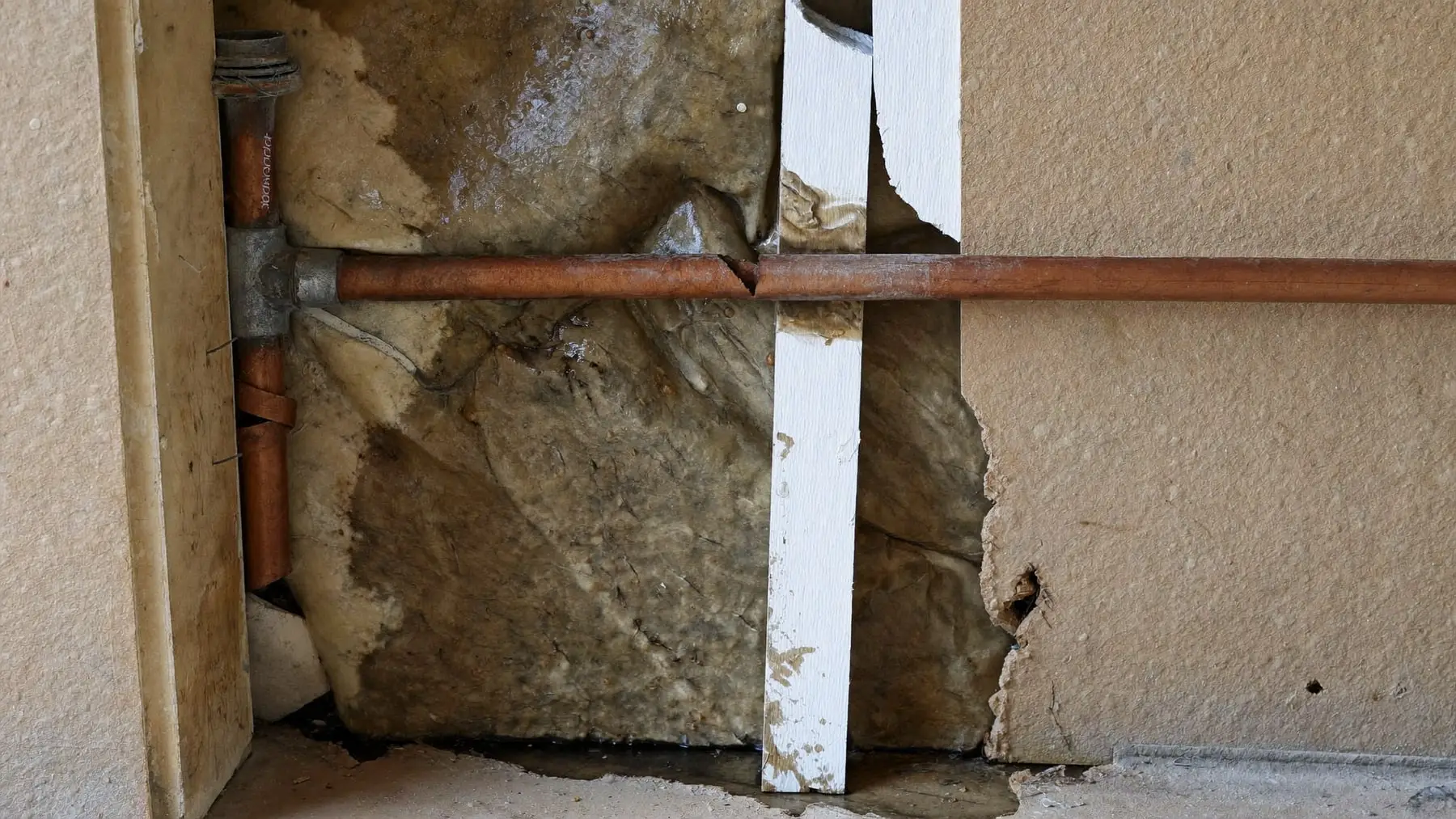
A pipe that bursts on a January night is an accident. A fitting that wept behind a wall for eight months until the floor went soft is deterioration. The damage can look identical when the wall comes off. Only one of them gets paid.
What a standard policy does cover
The Insurance Information Institute lists these among the perils covered on an HO-2 form and above, which is what most homeowners have:
- Accidental discharge or overflow of water or steam from within a plumbing, heating, air conditioning or automatic fire-protective sprinkler system, or from a household appliance
- Freezing of a plumbing, heating, air conditioning or automatic fire-protective sprinkler system, or of a household appliance
In plain terms, that is the burst supply line, the failed water heater, the washing machine hose that let go while you were at work, the dishwasher that overflowed, the upstairs bathroom that ran over into the ceiling below.
One detail people get wrong: the policy generally pays to repair the damage the water caused, not the component that failed. It replaces the soaked drywall, flooring and insulation. It does not usually buy you a new water heater.
What it does not cover
Three exclusions account for nearly every denied claim, and each needs a different fix.
1. Flood
Flood damage is excluded under standard homeowners and renters insurance policies.
That is the Triple-I wording, and it is absolute. There is no version of a standard homeowners policy that pays for flood. Flood means water arriving from outside and below: surface water, rising groundwater, an overflowing creek, storm runoff coming in through a window well.
Cover for it is a separate policy, through the National Flood Insurance Program or a private insurer. Two things about NFIP that matter before you need it:
- Limits are $250,000 for the structure and $100,000 for contents, sold separately
- There is a 30 day waiting period before a new policy takes effect
That waiting period is the part that hurts. You cannot buy flood cover when the forecast turns. The decision has to be made months ahead of the water.
2. Sewer and drain backup
Sewer backups are not covered under a typical homeowners insurance policy, nor are they covered by flood insurance.
This one catches people badly, because it falls in the gap between two policies. Neither your homeowners policy nor a flood policy pays for wastewater coming up through a floor drain or a toilet.
The fix is a water backup and sump overflow endorsement, added to the homeowners policy. It is inexpensive relative to what a backup costs, and it typically covers sump pump failure as well as sewer and drain backup. If your property has a finished basement, a sump pit, or a lateral line old enough to have tree roots in it, this is the single most worthwhile endorsement on the list.
3. Gradual damage and maintenance
The slow leak is not insurable. Neither is rot, nor wear, nor the consequences of a repair you kept putting off. Carriers take the position that these were preventable, and they are generally right.
This is where the clock does real damage. A sudden covered loss that sits unreported for a fortnight starts to look like a gradual one, and mould that develops in the meantime gives the carrier a second reason to reduce the claim. Speed is not just about saving the building. It is about keeping the loss inside what the policy will pay for.
Why this bites harder in Lincoln
Three local conditions push Lincoln properties toward the excluded side of the line more often than the covered side.
Heavy clay soil. Much of the Lincoln area drains slowly, so water pools against foundations rather than soaking away. When it finds a crack or a window well, what enters is groundwater, and groundwater is flood. A homeowners policy will not touch it.
Hard winter freezes. Nebraska winters routinely drop well below freezing, and frozen pipes split. The damage from those is normally covered, with the one large caveat above about leaving a property unheated.
Salt Creek and its tributaries. Properties on the lower ground near the creeks carry genuine flood exposure, which means the 30 day waiting period is something to think about in autumn rather than in spring.
The practical consequence is that a Lincoln homeowner with only a base policy is uncovered for two of the three ways water most commonly gets into a basement here.
What to do in the first hour
The order matters, and the first four are all free.
- Stop the water at the main shutoff if the source is plumbing. Know where that valve is before you need it, and check it actually turns.
- Photograph and video everything before you move anything at all. This is the single highest value thing you will do, and it takes four minutes. Claims are argued from documentation, and the documentation has to exist before the cleanup.
- Report it to your carrier. Prompt notice is a policy condition, not a courtesy.
- Keep every receipt, including emergency mitigation. Reasonable mitigation is normally reimbursable.
- Start drying. Your policy requires you to prevent further damage, so calling a restoration contractor is expected of you rather than something that works against the claim.
Two things not to do: do not throw damaged items out before they are documented, and do not wait for the adjuster before stopping the water. Waiting is the one decision that reliably makes a claim worse.
Before you need any of this
Take ten minutes with your current policy and find three things:
- Do you have a water backup and sump overflow endorsement? If there is a basement, you probably want one.
- What is your deductible, and is it a flat amount or a percentage?
- Is there a mould sublimit, and what is it?
If you are near a creek or on low ground, the flood question is worth asking at the same time, because of that waiting period.
General information only, not insurance advice. Coverage depends on your specific policy, your carrier and the facts of the loss. Read your own policy and speak to your agent or the Nebraska Department of Insurance about your situation.